Chasing Light and Legacy: Manila’s Soul Through My Lens
Manila isn’t just a city—it’s a living canvas. From golden-hour shots in Intramuros to vibrant street scenes in Quiapo, every frame tells a story. I went searching for culture and found it bleeding through every shutter click. If you’ve ever wanted to photograph a place that feels real, not staged, Manila will rewrite your definition of authentic. This is travel photography at its most raw and rewarding. It’s not about perfection in composition, but truth in emotion. The city does not pose—it simply exists, loud and layered, pulsing with history and heartbeat alike. For the mindful photographer, Manila offers not just images, but meaning. Here, every alleyway, every face, every flicker of light carries memory and motion, inviting you to see beyond the surface and into the soul of a people shaped by centuries of change, faith, and resilience.
Why Manila? The Photographer’s Unexpected Muse
Many travelers bypass Manila for the tranquil beaches of Palawan or the rolling hills of Bohol, seeking serenity over city bustle. Yet for the photographer attuned to authenticity, Manila is an inexhaustible well of visual narrative. Its chaotic rhythm—honking jeepneys, chattering markets, children playing between laundry lines—is not disorder, but life in its purest form. Unlike the carefully composed scenes of postcard destinations, Manila unfolds without rehearsal. There is no curtain call, only the daily performance of survival, celebration, and devotion.
The city’s layered past—Spanish colonial rule, American occupation, Japanese wartime presence, and Filipino independence—has left a mosaic of architectural and cultural imprints. In one neighborhood, you’ll find Baroque churches with coral stone walls; in the next, Art Deco buildings from the 1930s stand beside modern glass towers. This contrast is not accidental—it is the essence of Manila’s visual language. A grandmother in a traditional floral dress may walk past a mural of modern street art, while a jeepney painted with pop culture icons rumbles down a centuries-old street. These juxtapositions create storytelling opportunities that no studio set could replicate.
What makes Manila especially compelling is its refusal to sanitize itself for visitors. There is beauty in the weathered, the worn, the lived-in. Cracked sidewalks, rusted railings, and peeling paint are not flaws to be hidden but textures to be celebrated. The city does not hide its struggles; instead, it transforms them into art. A clothesline strung between buildings becomes a spontaneous installation. A child’s chalk drawing on pavement turns a corner into a gallery. For the photographer, this means every turn offers a potential frame—not because it is picturesque, but because it is honest.
Manila rewards those who slow down, observe, and listen with their lens. It asks not for admiration, but understanding. To photograph this city well is to recognize that every image is a collaboration between subject and observer, a moment of shared humanity. The city does not perform. It simply lives—and in that living, it offers a masterclass in visual storytelling.
Intramuros: Where Time Stands Still in Stone and Shadow
If Manila is a living canvas, then Intramuros is its oldest and most solemn brushstroke. This walled city, built by the Spanish in the 16th century, stands as a monument to colonial ambition and enduring Filipino resilience. Today, it is a sanctuary of history, where time seems to pause beneath the arches of weathered stone. For photographers, it offers some of the most atmospheric conditions in Southeast Asia—soft morning light filtering through ancient gates, long shadows stretching across cobblestone streets, and the quiet echo of footsteps on centuries-old pavement.
Dawn is the golden hour within a golden city. Arriving before 6:30 a.m. ensures solitude and the best lighting. At Puerta del Sol, the eastern gate, the rising sun casts a warm glow across the battlements, turning the thick stone walls into a canvas of amber and shadow. This is the perfect moment for silhouette photography—figures walking along the ramparts, their outlines sharp against the brightening sky. A wide-angle lens captures the sweep of the fortifications, while a telephoto can isolate details: the texture of coral limestone, the ironwork of a rusted lantern, or the intricate carvings above a chapel door.
San Agustin Church, a UNESCO World Heritage Site, is a masterpiece of light and reverence. Inside, the dim interior creates a chiaroscuro effect—beams of sunlight pierce through high windows, illuminating dust motes and gilded altars. This natural contrast is ideal for black-and-white photography, where tonal range conveys both grandeur and intimacy. When a mass is in session, the atmosphere deepens. Candles flicker, voices rise in prayer, and the scent of beeswax fills the air. Photographing these moments requires discretion. Always seek permission from church authorities, avoid using flash, and keep a respectful distance. The goal is not to capture spectacle, but sanctity.
Later in the day, the light shifts. By mid-morning, the sun climbs high, bleaching out contrast and flattening textures. This is not ideal for exterior shots, but it reveals details in the open courtyards and gardens. The gardens of Casa Manila, for instance, offer symmetry and color—hibiscus blooms, manicured hedges, and colonial-style fountains. These spaces invite still-life compositions, where architecture and nature coexist in quiet balance. In the late afternoon, as the sun dips westward, the western walls glow with a honeyed light. This is the time to return to the ramparts, now facing the sunset, and photograph the city skyline beyond—modern towers rising behind ancient fortifications, a visual metaphor for Manila itself.
Quiapo and the Pulse of Filipino Faith
No place in Manila pulses with more energy than Quiapo, the heart of Filipino Catholic devotion. At its center stands the Quiapo Church, home to the revered image of the Black Nazarene—a dark wooden statue of Christ believed to perform miracles. Every Friday, thousands gather to touch the ropes that pull the carriage during the annual procession. The air hums with prayer, incense, and the constant murmur of vendors selling candles, rosaries, and religious medals. For the photographer, this is not just a scene—it is a sensory immersion.
Capturing the emotion of Quiapo requires more than a lens; it demands empathy. The faces here tell stories of hope, hardship, and healing. A woman kneels with tears on her cheeks. A man presses his forehead to the church steps. A child sleeps in his mother’s arms, both wrapped in prayer scarves. These moments are not for exploitation, but for respectful documentation. Approach with humility. Use a telephoto lens when necessary to avoid intrusion, and never block pathways or disrupt rituals. When photographing individuals, a simple nod or gesture of asking—hands clasped in thanks—can go further than words.
The visual palette of Quiapo is overwhelming in the best way. Neon signs in red and blue blink above stalls selling everything from holy cards to herbal remedies. The church façade, weathered by time and smoke, bears cracks that seem to hold prayers. At golden hour, the low sun transforms the scene—turning dust into gold, casting long shadows, and illuminating the faces of devotees in a warm, almost divine light. This is the time to focus on details: hands clasped in prayer, the texture of a worn rosary, the glow of candle flames reflected in eyes.
Wide-angle lenses excel in crowded spaces, capturing the scale of devotion. A single frame can include hundreds of people, a sea of bowed heads, and the towering image of the Nazarene behind glass. But don’t neglect the intimate. Zoom in on a vendor’s hands arranging candles, or a priest blessing a child. These close-ups carry emotional weight. Night photography here is equally powerful. The church remains lit long after dark, its dome glowing like a beacon. Street lamps and lanterns cast pools of warm light, while smartphone flashes from pilgrims create spontaneous stars in the darkness. These images do not just record a place—they capture a people’s enduring faith.
Street Food Scenes: Capturing Culture One Bite at a Time
In Manila, food is not just sustenance—it is celebration, identity, and survival. The city’s street food culture is a photographer’s dream: vibrant, kinetic, and deeply human. From the sizzle of *isaw* (grilled chicken intestines) on charcoal grills to the gentle call of the *taho* vendor at dawn—“Tahoooo!”—every bite comes with a story. These scenes are not staged for tourists; they are the rhythm of daily life, played out on sidewalks, under tarps, and beside bustling intersections.
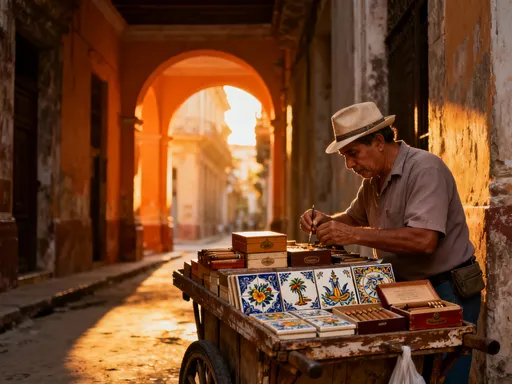
To photograph street food well is to honor the people behind it. Most vendors are working-class Filipinos—often women—who rise before sunrise to prepare their goods. A *taho* cart, for example, requires boiling soy milk, making soft tofu, and mixing arnibal (sweet syrup with tapioca pearls). The cart itself, painted in bright colors, becomes a mobile stage. At first light, the steam rising from the buckets creates a dreamy haze, perfect for soft-focus shots. Use a shallow depth of field to isolate the vendor’s hands ladling the warm dessert into cups, while the background blurs into golden morning light.
Night markets in Binondo, the world’s oldest Chinatown, and Divisoria offer a different energy. Here, the air is thick with smoke from woks, the clatter of chopsticks, and the glow of red lanterns. *Adobo*, *sinigang*, and *lumpia* sizzle on grills, their colors intensified under warm lighting. A tripod is useful for long exposures, capturing the motion of cooking—spoons flipping *tocino*, flames leaping under pans—while keeping the scene sharp. Natural light is best, but when artificial, choose warm tones to preserve the mood.
Focus on textures: the glisten of oil on *lechon*, the crispness of *kwek-kwek* (battered quail eggs), the steam curling from a bowl of *pancit*. These details tell the story of flavor and effort. Always ask permission before photographing vendors. A smile, a small purchase, and a thank-you go a long way. Many will welcome the attention, especially if they feel respected. Some may even invite you to try their food—a gesture that deepens connection and understanding.
These images do more than showcase cuisine; they document resilience. A vendor working late into the night, a family sharing a meal on a plastic mat, a child licking sauce from his fingers—these are moments of dignity and joy. In photographing them, we preserve not just food, but culture.
Jeepneys: Rolling Art Galleries in Motion
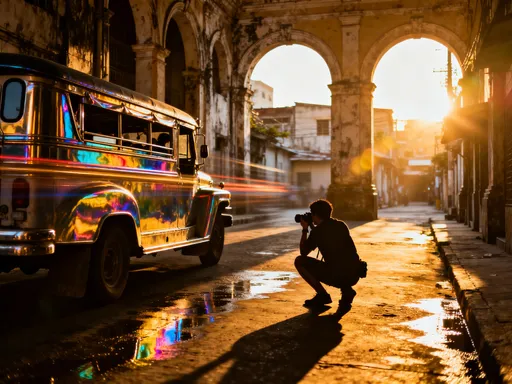
No symbol of Manila is more iconic than the jeepney. Born from U.S. military jeeps left after World War II, these buses have been stretched, welded, and painted into something entirely Filipino. Today, they are moving murals—bursting with color, slogans, and personal expression. From biblical verses to pop culture icons, from family names to lucky numbers, every inch tells a story. To photograph a jeepney is to capture not just a vehicle, but a cultural artifact.
Shooting them in motion requires technique. Use a slow shutter speed—around 1/15th of a second—with panning to blur the background while keeping the jeepney sharp. This conveys speed and energy. Early mornings offer the best light, with the sun low and golden, reflecting off chrome bumpers and painted metal. Terminals like EDSA Cubao or Quiapo Church are ideal for static shots. Here, jeepneys park in rows, their designs on full display. Take time to study each one—some feature saints, others superheroes; some declare “God Is Love,” while others boast “Number One Driver.”
The artistry is not random. Many designs reflect the driver’s beliefs, hopes, or family. Religious stickers are common—images of the Virgin Mary, the Sacred Heart, or the Black Nazarene are believed to offer protection. Personalized plates often include birth years, children’s names, or lucky numbers. These details invite closer inspection. A macro lens can capture the chipped paint, the rust beneath the glitter, the layers of stickers pasted over decades. These imperfections are not flaws—they are records of journeys taken, storms weathered, and miles survived.
Photographing jeepneys is also an act of preservation. As the government pushes to modernize public transport with cleaner, standardized vehicles, traditional jeepneys are gradually being phased out. Each photo becomes a historical document, a tribute to a vanishing way of life. While the new models are safer and more efficient, they lack the soul of the old. In capturing these rolling galleries, we honor not just design, but identity—the Filipino spirit of *diskarte* (resourcefulness), faith, and pride in the handmade.
Local Workshops: Learning from Manila’s Emerging Photographers
One of the most transformative moments of my Manila journey was joining a photo walk led by a local collective. These weekend excursions, often free or donation-based, connect visiting photographers with emerging Filipino lens artists. We met in Sampaloc, a district often overlooked by tourists, and spent the day wandering streets lined with old university buildings, sari-sari stores, and street vendors. Our guide, a photography teacher from a nearby college, didn’t just show us locations—he shared context.
He pointed out how light falls differently in narrow alleys, how children play in doorways at certain times of day, and where street food vendors set up at dusk. More importantly, he taught us how to approach people with respect. In Sta. Cruz, we photographed a group of women sorting dried fish under a tarp. He introduced us, explained our purpose, and waited for their consent. When they smiled and nodded, the images we captured were not of poverty, but of dignity and community.
These workshops open doors to neighborhoods rarely seen by outsiders. Sampaloc, Quiapo, and Tondo are not postcard-perfect, but they are real. They offer unfiltered access to urban Filipino life—students walking to class, families shopping at wet markets, elders playing chess in parks. Local photographers see beauty in what others might overlook: a patch of graffiti that reads “Hope,” a child’s drawing taped to a wall, a stray dog napping in a sunlit doorway.
Even informal interactions can be enlightening. Sitting near Rizal Park with a notebook, I struck up a conversation with a street photographer selling prints. He showed me his favorite spots—where the light hits the fountain just right, where fishermen gather at dawn. We exchanged tips, not just about settings and lenses, but about patience and presence. He reminded me that photography is not about taking, but about giving attention. In Manila, where life moves fast, slowing down to truly see is the greatest gift a photographer can offer.
Ethics, Equipment, and the Art of Seeing
Manila taught me that the most important tool in photography is not the camera, but the heart. I traveled with a basic mirrorless camera and a 35mm prime lens—simple, lightweight, unobtrusive. This setup forced me to get closer, to engage, to compose with intention. I learned that a technically perfect image means little if it lacks empathy. The best photographs are not those with the sharpest focus, but those with the deepest connection.
Ethical considerations are paramount. Always ask before photographing people, especially in vulnerable or sacred settings. A smile, a gesture, or a few words in Tagalog (“Pwede po?”—May I?) can build trust. Avoid using long zoom lenses to capture private moments from a distance—that is voyeurism, not photography. Dress modestly and blend in. A bulky camera bag and touristy clothes draw attention; a simple shirt and a discreet camera invite acceptance.
Use a local SIM card with GPS navigation to move confidently through neighborhoods. Learn basic phrases, respect local customs, and support small vendors. If you photograph a street food seller, buy something. If you take a portrait, offer to send a copy. These small acts create reciprocity and respect. Never engage in poverty tourism—photographing hardship for shock value or likes. Manila’s challenges are not your content. Instead, focus on resilience, joy, and everyday beauty.
Finally, remember that photography is a privilege. Every click is a choice—to honor or to exploit, to connect or to consume. In Manila, where history is etched in stone and spirit is worn on sleeves, the most powerful images are those that reflect not just what we see, but how we see. Pack your lens, charge your battery, but leave behind assumptions. The real Manila is not in the guidebooks. It is in the laughter of children chasing a rubber ball, in the hands of an elder lighting a candle, in the quiet pride of a jeepney driver polishing his painted masterpiece. It is waiting—not to be captured, but to be witnessed.
Conclusion
Manila does not perform for the camera—it simply lives. And that is precisely what makes photographing it so powerful. Each shutter click becomes more than an image; it becomes a record of resilience, faith, and joy. The city does not offer perfection. It offers truth. Whether you are chasing the soft light of dawn in Intramuros, the fervent prayers in Quiapo, or the laughter of children in a backstreet game of piko, Manila rewards those who look deeper. It asks for no filters, no staging, no pretense. It only asks that you see it as it is—complex, contradictory, and profoundly alive.
This is not a city of postcard moments, but of human ones. The beauty here is not in symmetry, but in survival. Not in silence, but in song. To photograph Manila well is to listen with your lens, to move with humility, and to honor the stories you are privileged to witness. So pack your gear, but leave your assumptions behind. Charge your batteries, but also your curiosity. The real Manila is not hidden—it is everywhere, in plain sight, waiting not to be staged, but to be felt. And when you finally lower your camera, you may find that the deepest image is not on your memory card, but in your heart.