Where Art Meets Earth: Goa’s Wild Landscapes That Paint Themselves
You know that feeling when nature looks so unreal, it’s like someone painted it just for you? That’s Goa—not just beaches and parties, but a living canvas. I’m talking lush jungles, golden paddy fields, misty hills, and rivers that wind like brushstrokes. Through an artist’s eyes, every curve of this land tells a story. This is more than travel—it’s inspiration found in the wild, quiet corners most people miss. While postcards celebrate its sun-drenched shores, the deeper soul of Goa reveals itself in subtler strokes: in the way morning light filters through a rainforest canopy, how rice fields shimmer like liquid gold at harvest, or how riverbanks glow in hues no pigment can truly match. This is a place where art isn’t just made—it grows.
The First Brushstroke: Arrival in Goa Beyond the Postcard
When most travelers think of Goa, they picture turquoise waters lapping against sandy coves, beach shacks pulsing with music, and sun-bleached tourists lounging under palm trees. And yes, those scenes exist—but they are only one shade on a much broader palette. The true essence of Goa begins where the highway curves inland, where traffic thins and the air grows thick with the scent of damp earth and wild jasmine. This is the Goa that artists and quiet seekers return to again and again: a land shaped by the Western Ghats, cradled by river valleys, and stitched together by emerald-green forests and terraced fields.
As the foothills of the Sahyadri range slope gently into the coastal plains, a different rhythm emerges. Here, nature doesn’t perform—it simply is. The light shifts slowly, painting the hills in soft gradients of green and gray. Villages tucked into the folds of the land maintain a pace untouched by the frenzy of coastal tourism. Houses with red-tiled roofs sit nestled among jackfruit and cashew trees, their walls washed in ochre and terracotta, colors drawn directly from the soil. This is where the first brushstroke of Goa’s natural artistry appears—not in grand gestures, but in the quiet harmony between land and life.
Travelers who venture beyond the well-trodden coast discover that Goa’s beauty is not static. It breathes. It changes with the monsoon’s arrival, the tilt of the sun, the turning of the seasons. And in these transformations, there is a kind of artistry that no gallery could contain. To see Goa this way is to witness a landscape that paints itself—daily, silently, magnificently.
Jungles That Breathe: The Lush Heart of Goa’s Wilderness
Deep within Goa’s interior lies a world untouched by time—the dense, humid rainforests that pulse with life and mystery. In the Bhagwan Mahavir Wildlife Sanctuary, one of the state’s largest protected areas, the jungle wraps around you like a living tapestry. Towering trees, some centuries old, form a canopy so thick that sunlight filters through in scattered pools, like dabs of gold on a canvas. Vines twist like calligraphy across trunks, and moss blankets boulders in velvet green. Every step forward is a step into a different atmosphere—one where silence is broken only by the cry of a Malabar trogon or the rustle of a mongoose darting through the undergrowth.
This is not scenery to be viewed from a distance. It must be felt. The jungle engages all the senses: the dampness in the air, the earthy scent after rain, the coolness beneath your feet. It is a place where nature’s textures—rough bark, slick leaves, tangled roots—resemble the bold, expressive strokes of abstract art. Artists have long been drawn to such places, not to replicate what they see, but to absorb its energy. In these forests, form is not imposed—it emerges. A fallen tree becomes a bridge for orchids. A stream carves its own path with patient precision. There is no need for human intervention; the composition is already complete.
One of the most breathtaking expressions of this wild artistry is Dudhsagar Falls, a four-tiered cascade that plunges 310 meters through the jungle. The name means “sea of milk,” and for good reason—the water tumbles in frothy white ribbons against dark rock, surrounded by a mist that softens every edge. To reach it, one must hike through shaded trails or board a narrow-gauge train that snakes along the edge of the forest. The journey itself becomes part of the experience, a slow unveiling of nature’s grandeur. Here, the jungle doesn’t just exist—it performs, with light, water, and sound as its instruments.
Rivers as Living Lines: The Flow That Shapes the Land
If the jungle is Goa’s heart, its rivers are its veins—dynamic, life-giving, and endlessly expressive. The Mandovi, Zuari, Chapora, and their smaller tributaries do more than connect places; they shape the land, carving valleys, nourishing fields, and reflecting the sky in ever-changing patterns. From above, they look like brushstrokes—sinuous, deliberate, flowing with purpose. But to truly understand their artistry, one must move with them.
A bamboo raft ride along the Netravali stretch of the River Galgibaga offers a rare intimacy with water in motion. Floating gently downstream, you glide past overhanging trees, their branches trailing in the current like paintbrushes dipped in green. The water shifts from translucent silver to deep indigo, depending on the time of day and the thickness of the cloud cover. There are no engines, no loud voices—just the soft dip of paddles and the occasional call of a kingfisher. In moments like these, the river becomes a meditation on flow, on the beauty of movement that follows its own rhythm.
Further north, kayaking through the Cumbarjua Canal at sunset reveals another dimension of Goa’s aquatic art. The narrow waterway, flanked by mangroves, reflects the sky in mirror-like stillness. As the sun dips below the horizon, the water ignites—first in gold, then in rose, then in deep violet. The mangrove roots, twisted and gnarled, rise from the surface like sculptures, their forms exaggerated in the fading light. This is where line and shadow dance, where the boundary between water and sky dissolves. Artists have long sought such moments, not to capture them exactly, but to carry their essence forward into new creations.
These rivers are not just scenic—they are vital. They sustain agriculture, support biodiversity, and anchor local communities. Yet they also serve as natural canvases, their surfaces constantly redrawn by wind, light, and tide. To witness them is to understand that art is not always made by hands. Sometimes, it flows.
Fields of Gold: Rice Terraces and the Art of Seasonal Change
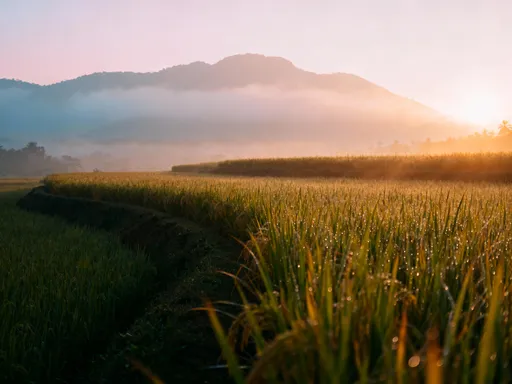
Between June and January, a quiet miracle unfolds across Goa’s countryside. What was once dry, cracked earth transforms into a vast expanse of shimmering green, then ripens into waves of golden light. The paddy fields of villages like Assagao, Pomburpa, and Sattari are not just agricultural spaces—they are seasonal masterpieces, painted anew each year by farmers who work in harmony with nature’s cycle.
From a distance, the fields resemble a textile in motion—rows of rice stalks swaying in unison, catching the wind like threads in a loom. The patterns shift with the sun: in the morning, they glow with a soft, silvery hue; by midday, they blaze in bright green; and at harvest, they turn into a sea of amber, ready to be gathered. This transformation is not random. It is the result of careful planting, precise irrigation, and generations of knowledge passed down like heirloom seeds.
What makes these landscapes so artistically compelling is their temporality. Unlike a painting hung on a wall, a rice field exists only for a season. Its beauty is fleeting, tied to the rhythm of monsoon rains and harvest moons. Yet in that brevity lies a kind of perfection. There is no attempt to preserve or perfect—it simply is, in its moment. Farmers, often seen bent over in the fields at dawn, are not just laborers; they are collaborators in a natural process that produces both food and form.
For the mindful traveler, walking along the narrow dirt paths between fields offers a chance to slow down and observe. You might see a heron stalking through the water, or a buffalo resting in the shade of a banyan tree. The air hums with insects, and the scent of wet soil rises after a sudden shower. These are the details that make the scene alive—not just a picture, but a living, breathing composition. And when the harvest comes, and the fields are cleared, the land rests, ready to begin again. In this cycle, there is a quiet lesson in impermanence, and in the beauty of renewal.
Coastal Contrasts: Cliffs, Dunes, and the Drama of Light
While many flock to Goa’s flat, sandy beaches, the true drama of its coastline unfolds in the less-trodden stretches where land meets sea with force and flair. Morjim’s rocky headlands, Agonda’s wild dunes, and Cabo de Rama’s cliffside promontories reveal a different kind of beauty—one shaped by wind, tide, and time. These are not passive shores, but dynamic landscapes where nature’s sculptural power is on full display.
At Cabo de Rama, an ancient fort sits atop a high cliff overlooking the Arabian Sea. From this vantage point, the ocean stretches endlessly, its surface shifting from deep blue to frothy white as waves crash against the rocks below. But it is the light that transforms this scene into art. At sunrise, the stone walls of the fort glow in warm orange, while the sea catches the first light in shimmering streaks. By sunset, the sky becomes a canvas of crimson, violet, and gold, reflected in the wet sand like a watercolor left to bleed. These are fleeting moments, impossible to replicate, yet they leave a lasting impression on anyone who witnesses them.
Further south, Agonda Beach offers a more secluded experience. Here, sand dunes rise like waves frozen in time, covered in native grasses that bend with the wind. Unlike the packed beaches of North Goa, Agonda remains relatively untouched, its shoreline shared with nesting turtles and wandering fishermen. At low tide, the receding water leaves behind intricate patterns—ripples, ridges, and pools—that resemble etchings on a vast, natural plate. These are not designs made by hand, but by the quiet, persistent work of water and wind.
Artists have long been drawn to such coastal contrasts, not for their convenience, but for their authenticity. There is no need to enhance what is already so vivid. The colors are real. The textures are earned. And the light—ever-changing, ever-dramatic—invites not just observation, but reverence.
Hidden Canvases: Offbeat Villages Where Nature and Craft Coexist
Some of Goa’s most enduring art isn’t found in galleries—it’s woven into the fabric of daily life in its quietest villages. In places like Loliem, Savoi, and Quepem, traditional Goan homes stand surrounded by lush gardens, their courtyards filled with handmade tiles, terracotta pots, and carved wooden doors. These objects are not merely decorative; they are expressions of a deep connection between people and place, where art grows from the land itself.
Take the red oxide tiles that crown so many Goan roofs. Their color comes from the iron-rich clay found in local soil, baked under the same sun that ripens mangoes and cashews. The tiles don’t just protect—they reflect, absorbing heat during the day and releasing it slowly at night. Similarly, terracotta pottery, used for cooking and storage, is shaped from natural clay and fired in simple kilns. The vessels, often unglazed, carry the warmth of the earth in both texture and tone. These are crafts born of necessity, refined over time into quiet elegance.
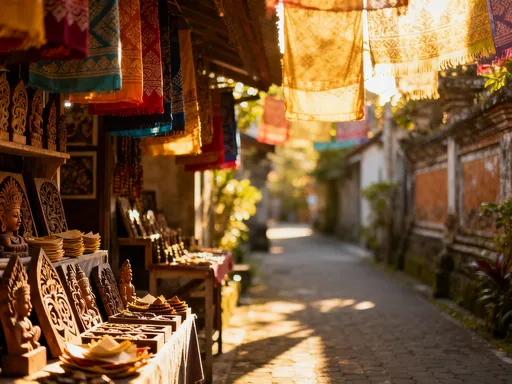
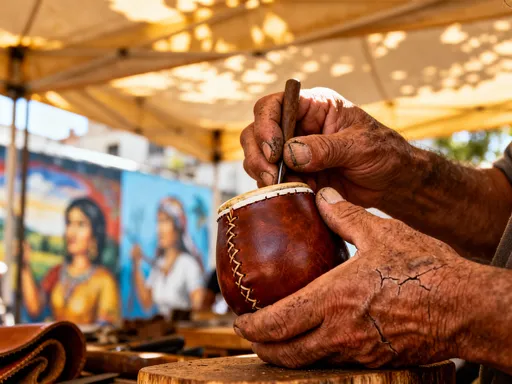
Wood carving, another traditional art, draws inspiration from the surrounding forests. Intricate designs on doors, balconies, and furniture often feature floral motifs, peacocks, and geometric patterns—symbols rooted in both nature and heritage. The craftsmen who create them work slowly, by hand, using tools passed down through generations. Their art is not rushed, not mass-produced. It is patient, like the growth of a banyan tree.
In these villages, creativity is not separate from living. It is part of it. Women grind natural pigments for wall paintings; men weave baskets from palm leaves; children learn songs that speak of seasons and harvests. Every object, every gesture, carries a piece of the landscape. To visit these places is to see how art, when rooted in place, becomes a form of belonging.
Seeing Like an Artist: How to Experience Goa’s Natural Beauty Deeply
Beauty is everywhere in Goa—but truly seeing it requires more than a camera. It requires presence. Anyone can look at a river or a rice field, but to *see* it—to feel its texture, understand its rhythm, absorb its silence—means slowing down. It means choosing a footpath over a highway, a sketchbook over a screen, a quiet morning over a crowded afternoon.
One of the most powerful ways to deepen your experience is to travel with an artist’s mindset. This doesn’t mean you need to paint or draw—though carrying a small notebook can help. It means observing with intention. Notice how light falls on a leaf. Listen to the way wind moves through bamboo. Feel the difference between the cool shade of a forest and the open heat of a field. These details are the brushstrokes of experience.
Timing matters. The soft, slanted light of early morning and late afternoon transforms ordinary scenes into extraordinary ones. A river at noon may look plain, but at golden hour, it becomes liquid fire. Similarly, the monsoon months—often avoided by tourists—reveal a Goa at its most lush and vibrant. The hills turn deep green, the waterfalls swell, and the air carries the scent of petrichor. These are not inconveniences; they are invitations to see differently.
Modes of travel also shape perception. Cycling through a village, walking a jungle trail, or paddling a kayak keeps you close to the land. You move at nature’s pace, not man’s. You notice things you’d miss from a car: a spiderweb glistening with dew, a farmer guiding a buffalo through a field, the sudden flash of a kingfisher’s wings. These moments don’t make for flashy photos—but they stay with you.
To see like an artist is to accept that not everything needs to be captured. Some beauty is meant to be felt, not saved. And in that act of letting go, you find a deeper connection—not just to Goa, but to the way the world reveals itself when you’re truly paying attention.
Conclusion: Taking the Landscape Home, Not as Photos but as Feeling
Goa’s true gift is not what you can photograph, but what you carry within you after you leave. The image of a sunset over the Mandovi may fade, but the stillness you felt in that moment—the hush of the water, the warmth on your skin, the sense of being completely present—can remain. That is the lasting art of this place: not in its views, but in its ability to awaken a deeper way of seeing.
The wild elegance of its rivers, the quiet strength of its forests, the golden rhythm of its fields—these are not just sights to be collected. They are invitations to slow down, to notice, to feel. They remind us that beauty doesn’t need to be loud or perfect to be profound. Sometimes, it is in the curve of a river, the pattern of plowed earth, or the way light touches a stone wall at dusk.
And when you return to your daily life—your kitchen, your garden, your morning walk—you may find that Goa has changed the way you see. A puddle reflects the sky like a miniature lake. A tree casts shadows that look like brushstrokes. The world, once ordinary, now pulses with quiet artistry. That is the real journey: not just to Goa, but into a way of being where every landscape, near or far, becomes a living canvas. You don’t take the place home. You let it reshape your eyes—and through them, your world.