This Is What Tahitian Architecture Taught Me About Slowing Down
You know that feeling when a place just *makes sense*? Tahiti did that for me—not with grand gestures, but in the quiet way its buildings breathe with the land. I went chasing views, but stayed for the architecture: open-air homes, thatched roofs swaying in the breeze, stone foundations older than memory. This isn’t just design—it’s a philosophy. Slow travel here isn’t a trend. It’s listening to how a roof angles to catch the wind, or how a doorway frames the sea. That’s the real magic.
Arrival with Intention: Why I Chose Slow Travel in Tahiti
After years of checklist tourism—hopping from landmark to landmark, ticking off Instagram spots before the light faded—I arrived in Papeete with no itinerary, no pressure, and no agenda beyond curiosity. My suitcase held lightweight clothes and a notebook; my mind held only space. Instead of booking an overwater bungalow with panoramic ocean views, I rented a modest guesthouse on Tahiti’s less-traveled east coast, where the road narrows and the jungle meets the sea. The owner, a local craftsman named Tere, greeted me barefoot on the porch, sipping fresh coconut water through a straw. He didn’t hand me a key—he invited me to sit, to listen to the waves, to feel the breeze move through the open-sided structure where I’d be staying.
That moment set the tone for everything that followed. This trip wasn’t about seeing more; it was about feeling more. Tahiti, I quickly realized, is not a destination you conquer. It’s a rhythm you sync with. The island operates on what locals call *fa’atere*, a gentle way of being that values presence over productivity. Its rhythm is in the tides, not in timelines. By shedding the modern urge to “maximize” every minute, I opened myself to subtle wonders: the way morning light filters through woven pandanus walls, casting delicate lattice shadows across the floor; the soft rustle of thatch responding to wind like a living thing; the quiet hum of community life unfolding without rush or noise.
Slow travel, in this context, became less of a choice and more of a necessity. The island resists haste. Roads wind slowly through valleys. Markets open when vendors arrive, not on a schedule. Conversations unfold in layers, not soundbites. And the architecture—open, breathable, rooted—reinforces this pace. I began to understand that to truly experience Tahiti, I had to stop performing travel and start living it. The buildings weren’t just shelters—they were invitations to slow down, to notice, to belong.
The Language of Thatched Roofs: Understanding Traditional Pārea Design
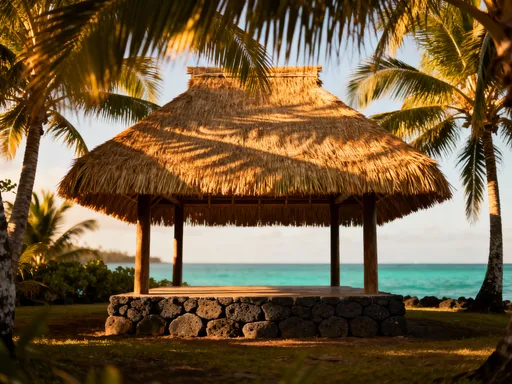
The most striking feature of traditional Tahitian architecture is the *pārea*—a simple yet profoundly intelligent structure defined by its open sides and steeply pitched thatched roof. Found in family compounds, village gathering spaces, and even modern reinterpretations, the *pārea* is more than a building type; it’s a cultural expression of climate wisdom and social philosophy. The roof, typically made from tightly bound *pandanus* leaves, rises high above the ground, creating a cathedral-like interior space that allows hot air to rise and escape, while drawing cooler breezes upward from the earth. Without walls, the structure remains in constant dialogue with the environment, adjusting naturally to shifts in wind and temperature.
I spent several mornings observing elders in a village near Mahina as they repaired a community *pārea*. Seated on low stools, they worked with quiet focus, layering fresh pandanus thatch over the existing frame. Each strip was tied by hand using coconut fiber cord, a technique passed down through generations. A well-maintained roof can last up to ten years, even in heavy rains, thanks to the natural water resistance of the dried leaves and the precision of the layering. What struck me was not just the craftsmanship, but the intention behind it: this was not construction as transaction, but as continuity. Every knot tied was a conversation with ancestors who first learned how to read the wind and respond to it.
The *pārea* also reflects a social ethos. Because there are no walls, conversation flows freely. Families gather beneath it for meals, elders share stories in the late afternoon, and children play in the shade without barriers. It’s a space designed for togetherness, not isolation. In a world where so much architecture prioritizes privacy and separation, the *pārea* stands as a quiet rebuke—a reminder that human connection thrives in openness. To sit under one is to feel part of a larger whole, sheltered not by walls, but by community and sky.
Stone Foundations and Ancestral Memory: The Role of Ancient Platforms
Scattered across Tahiti’s lush valleys and coastal edges are *marae*—sacred stone platforms that once served as ceremonial centers, places of worship, and community gathering spaces. These are not ruins in the Western sense, reduced to relics of a forgotten past. To the Tahitian people, *marae* are living anchors of identity, memory, and spiritual connection. Built without mortar, their construction relies on precise stone fitting, with each volcanic rock carefully selected and placed to create stable, enduring platforms. Some date back centuries, their origins lost to oral history, yet their presence remains palpable.
I visited one such site nestled in the Papenoo Valley, accessible only by a narrow trail flanked by taro fields and cascading streams. Our guide, a local historian named Hinatea, explained how each stone had been carried by hand from the nearby river, a testament to collective labor and reverence for place. The layout of the *marae* was intentional: aligned with solstice sunrises, positioned to frame mountain peaks, or oriented toward the sea. This was architecture as cosmology—built to reflect the relationship between people, land, and sky.
What moved me most was the silence of the place. No signs, no entry fees, no crowds—just stillness and the whisper of wind through palm fronds. Standing on the platform, I could feel the weight of time, not as something distant, but as something present. Today, many modern homes in rural areas echo the *marae* in subtle ways—using stone foundations, maintaining open layouts, or positioning doorways to face significant natural landmarks. This continuity is not nostalgia; it’s a conscious choice to ground the present in ancestral knowledge. In a world increasingly disconnected from history, Tahiti’s stone platforms remind us that belonging begins with remembering.
Modern Meets Traditional: How Contemporary Homes Honor the Past
In villages like Tautira and Arue, a quiet architectural evolution is underway—one that honors tradition without replicating it. Here, contemporary homes blend modern materials like concrete and glass with time-tested principles of airflow, shade, and openness. You’ll see houses with wide overhanging eaves, thatched roof extensions over outdoor patios, and wooden latticework used as natural sunscreens. These are not theme-park recreations of the past; they are thoughtful adaptations to present needs and environmental realities.
One homeowner, Moana, invited me into her family’s home near the coast. Built after a storm damaged their previous house, it features a concrete base for stability but retains the spirit of the *pārea* in its design. The kitchen opens completely to the garden through sliding wooden panels, allowing sea breezes to flow through during cooking. The living area has no air conditioning—instead, cross-ventilation and high ceilings keep the space cool even at midday. “We don’t fight the heat,” she said with a smile. “We work with it.”
Even eco-resorts are adopting this philosophy. Near Teahupo’o, I stayed at a small lodge built on elevated timber frames, inspired by traditional stilt houses. The rooms had louvered windows that could be adjusted to catch prevailing winds, and the common areas were open-air, shaded by deep roofs. The owner, a French-Tahitian architect, emphasized that their goal wasn’t to create luxury in the conventional sense, but comfort in harmony with nature. “Luxury here isn’t marble or chandeliers,” he told me. “It’s silence, shade, and the sound of waves.” This shift—from domination to collaboration—defines the most meaningful designs in modern Tahiti.
Materials That Breathe: Pandanus, Coconut Wood, and Coral Stone
Walking through a local market in Papeete, I noticed bundles of golden-brown leaves tied with twine—dried pandanus, sold by the armful for roofing and weaving. This fibrous plant, harvested sustainably from coastal groves, is central to Tahitian building culture. Flexible when fresh, it becomes strong and water-resistant when dried, making it ideal for thatch. Artisans strip the leaves, dry them in the sun, and braid them into sheets before layering them on roofs. The process is labor-intensive, but the result is a living material that breathes, expands, and settles with the seasons.
Coconut wood, often sourced from fallen or mature trees, is another staple. Used for beams, posts, and wall frames, it’s durable, aromatic, and naturally resistant to insects. Unlike imported timber, it carries no carbon guilt—it’s a gift from the land, used with gratitude. I joined a workshop in Moorea where artisans demonstrated how to prepare both materials, emphasizing that every step—from harvest to installation—is an act of respect. “We don’t take more than we need,” one elder told me. “The tree gives us wood, and in return, we care for the forest.”
Some older structures, particularly in inland areas, incorporate coral stone, quarried from offshore deposits during low tide. These stones, once lifted and shaped by hand, form sturdy, breathable walls that regulate temperature. Though less common today due to environmental protections, their legacy lives on in the preference for natural, locally sourced materials. What unites pandanus, coconut wood, and coral stone is not just utility, but connection. They are not extracted; they are gathered. They do not isolate; they link builder to land, family to environment, present to past.
The Social Architecture of Open Spaces
What struck me most about Tahitian homes was not their materials or form, but their radical openness. Most houses have no front doors, no locked gates, no solid walls facing the path. Instead, they feature wide verandas, open-air lounges, and kitchens that spill into gardens. Privacy is not enforced by barriers, but created through landscape—screened by banana trees, flowering frangipani, or tall heliconia. This is architecture designed for relationship, not retreat.
In villages, it’s common to see families cooking together outside, children napping on mats under shade sails, elders chatting on low benches. The house is not a private fortress, but an extension of community life. Even in towns, you’ll find *fare amicale*—community halls with high ceilings, no walls, and woven floors—used for celebrations, meetings, and shared meals. These spaces are designed for gathering, not storage. Their acoustics carry laughter, music, and conversation, reinforcing bonds through proximity and presence.
This social architecture stands in stark contrast to the isolating design of many modern urban homes, where windows face inward, doors stay locked, and neighbors remain strangers. In Tahiti, space is not a commodity to be guarded, but a shared resource to be enjoyed. I began to see how architecture shapes not just comfort, but character. When your home opens to the world, you learn to trust it. When your kitchen is outdoors, you invite others in. When your walls are low, you stay connected. It’s a subtle but powerful way of fostering belonging—one that feels increasingly rare in a fragmented world.
Designing for Resilience: How Tahitian Architecture Faces Climate Challenges
With rising sea levels, stronger storms, and shifting weather patterns, Tahiti’s traditional architectural wisdom is proving not just beautiful, but essential. Elevated homes, flexible roofing, and permeable layouts—features once developed for comfort—are now critical for survival. I spoke with a builder in Hitia’a who specializes in storm-resistant designs that integrate ancestral techniques. His homes are raised on sturdy wooden or concrete stilts, with roofs anchored using woven coconut fiber ropes that absorb shock during high winds. “Metal fasteners can snap,” he explained. “But natural fibers stretch and hold.”
These methods are not relics preserved in museums; they are evolving solutions. Government-supported programs now encourage hybrid designs that combine durability with cultural identity. For example, new coastal homes may use concrete foundations for flood resistance but retain thatched roofs and open layouts to maintain airflow and tradition. In some communities, *marae*-style stone platforms are being used as elevated community shelters during cyclones.
What’s clear is that resilience here isn’t about fortification, but adaptation. Instead of building higher walls, Tahitians are refining ways to live *with* the environment—letting water flow through, allowing wind to pass, using materials that bend rather than break. In a world grappling with climate uncertainty, this approach offers a powerful alternative to rigid, high-tech solutions. It suggests that the most sustainable designs are not always the newest, but the oldest—the ones that have already stood the test of time.
Conclusion: More Than Buildings—A Way of Being
Tahiti didn’t just show me buildings—it taught me how space can slow time. Every roof angle, every stone placement, every open doorway reflects a worldview rooted in harmony, resilience, and community. Slow travel, in this context, is not a luxury or a trend. It’s a necessity—a way of aligning with a place that operates on deeper rhythms. I learned to notice how people live *with* the environment, not against it: how a kitchen opens to the garden, how a roof catches the wind, how a village gathers under a shared roof.
As we face global challenges—from climate change to cultural disconnection—these architectural truths feel urgent. They remind us that design is not just about aesthetics or efficiency, but about values. The future of sustainable living may not lie in high-tech smart homes, but in the quiet intelligence of thatched roofs and stone platforms. It may lie in choosing materials that breathe, spaces that connect, and rhythms that honor nature’s pace.
What if we all lived a little more like this? What if our homes invited breeze instead of blocking it? What if our walls opened rather than closed? Tahiti’s architecture is not a museum exhibit. It’s a living lesson in how to build not just for today, but for generations. And perhaps, in learning to slow down, we might finally build something that lasts.